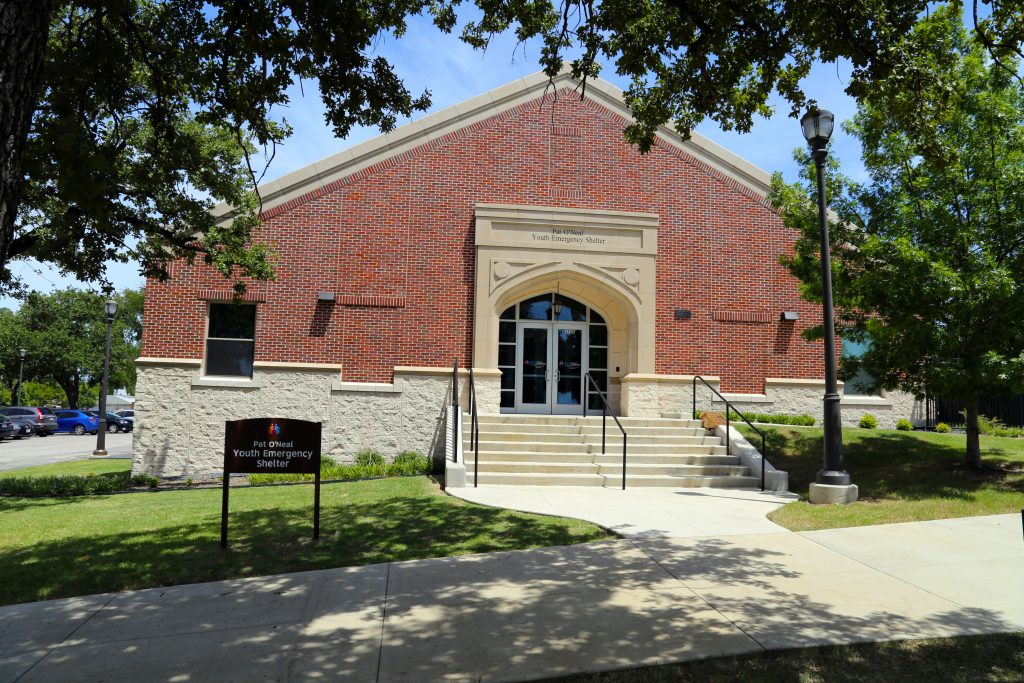

Category: Youth Emergency Shelter

A Safe Place to Start Over

After years of abuse, instability, and feeling hopeless, Natalie made the courageous decision to seek safety.

With support from ACH, she is now building the future she thought was out of reach.

A Childhood Marked by Trauma

Natalie had a tumultuous childhood. A car accident resulted in more than five surgeries for significant facial trauma. She was dyslexic. At just 8 years old, an investigation of child abuse led to a court order removing her from the care of her parents.

She was placed with her grandmother, but grandma would always take her back to her abusive dad. When she couldn’t take it anymore, she ran away.

Life Changing Support

She knew Safe Place was somewhere she could go and feel safe. Safe Place is a nationwide program that ACH administers locally at more than 250 locations in Tarrant County.

Once there, she was taken to ACH’s Pat O’Neal Youth Emergency Shelter and immediately received food, clothing, a medical screening, and therapy. At the Fort Worth Independent School District Charter School in the Shelter, she continued her high school classes and for the first time, got the help she needed for her dyslexia.

Moving Forward

The Shelter serves ages 10-17 and in March Natalie turned 18—the age when youth “age out” of foster care. The Shelter staff told her about ACH’s LIFE Project, a supervised independent living program for young adults ages 18 to 21. Now in LIFE, she continues to receive therapy to overcome years of abuse. She’s finishing high school and working on getting a job and is now on a good path to becoming self-sufficient.

About Safe Place

Safe Place is a locally-administered, national program that provides access to immediate help and safety for young people who are runaways, homeless, experience human/sex/labor trafficking, etc. In Tarrant County, this critical community safety net makes it possible for youth to get help fast at locations that display the distinctive yellow and black sign. 

Safe Place sites are developed in partnership with business and community locations that are easily accessible. Some current partnerships include QuikTrip, all Fort Worth Fire Departments, Trinity Metro, Community Centers, and The Underground.

A Place to Be a Kid

In just a few days at ACH’s Youth Emergency Shelter, Sayde experienced something she’d never known before:

Safety, stability, and the freedom to be a child.

At an age when most children were worrying about homework or clothes, Sayde was listening for footsteps in the house. She knew the sound of anger before it arrived, learned how to stay quiet to stay safe, and carried responsibilities far heavier than her years. As a child, she moved through the world alert and guarded, as both of her parents were addicted to drugs and physically and mentally abusive.

By the time she was 13 years old, Sayde had learned to take care of herself, as well as her 4-year-old brother. What she had never learned was what it felt like to simply be a kid.

That changed briefly but profoundly when she arrived at ACH’s Youth Emergency Shelter.

Sayde came to ACH on her first day of 8th grade. Child Protective Services picked her up from school, brought her to their office while they searched for a safe place to stay, and determined ACH was the safest, most stable respite. Her brother was able to be placed with a kinship caregiver who – for unknown/undisclosed reasons – could care for him but not Sayde.

So, Sayde arrived at ACH’s Pat O’Neal Youth Emergency Shelter scared and exhausted, without her brother, her new outfit for 8th grade as the only belongings to her name.

What she found at ACH was something entirely new: calm.

“At ACH, I didn’t have to worry,” Sayde says. “For the first time, there were adults who were watching out for me, and I didn’t have to carry everything by myself.”

Safety in the Small Moments

Her stay was short, just a handful of days, but the impact was lasting. Staff welcomed her without judgment. They helped her find clothes that fit. They introduced routines, such as chores, mealtimes, schoolwork, and bedtime. Ordinary things that, for Sayde, felt special. She’d never had a parent set those expectations. At the shelter, adults responded instead of reacting. Rules existed, but so did kindness. When kids struggled, staff didn’t yell or hide in their bedroom doing drugs. They helped.

Most importantly, ACH let Sayde be a child.

She remembers doing schoolwork on a computer, trying new foods she’d never tasted before, and sitting at a table with other kids who, like her, carried heavy stories. When she was able to mentally process the emotional weight and toll of what was happening, she cried. But no one punished her or turned away. She says she remembers staff validating her feelings, and just “being there and letting her cry.”

“That was the only place in my childhood where I truly felt safe,” she says. “They treated me like I mattered. Like I was their kid, too.”

After leaving ACH, Sayde’s life remained difficult, but the experience at ACH stayed with her.

An Impact That Endured

Today, Sayde is a college graduate, a homeowner, a wife, and a mother. She is pursuing a master’s degree and raising her son with the stability and love she never had. When asked what motivates her, she doesn’t hesitate: she refuses to repeat the past.

And she never forgot the place that helped her survive it.

When given the opportunity to support an organization during the holidays, Sayde chose ACH without question. “In the hardest moment of my life,” she says, “ACH gave me something no one else did—the chance to just be a kid.”

About the Youth Emergency Shelter

The Pat O’Neal Youth Emergency Shelter (YES) is the only 24-hour emergency shelter in Tarrant County offering 24/7 safe shelter to runaway and homeless youth, and trafficking survivors, ages 5-17.  ACH works to reunite them with their families or find safe and stable alternative living arrangements. The program provides outreach, education, advocacy, counseling, and case management services for foster care and community youth who are experiencing family crisis, family conflict, or homelessness. With an average cost per child of $425 per night, the Shelter is facing a projected funding gap of $649,468. We welcome all gifts, large and small, that help give children safety, hope, and love.

From Panhandling to Stability

Panhandling

They had no school or structure, only survival, until ACH stepped in.

Lucas*, 16, and his siblings Isabella*, 17, and Dylan*, 15, were removed from their parents after they were found panhandling around Fort Worth. Their parents sent them out daily to ask for money.  For the children, there was no school, no structure, just survival. When Child Protective Services stepped in, the siblings were placed in the Pat O’ Neal Youth Emergency Shelter, one of ACH Child and Family Services 15 programs that serves children and families in North Texas.

Breaking Barriers

The challenges were clear from the beginning. The children refused to speak English and had no school records or history of formal education. The shelter’s team used the Trauma-Informed, Relationship-Based® approach (TBRI) to build trust, knowing the kids had every reason to be wary of adults.

At first, staff believed the children spoke Romanian. It turned out they spoke three languages, including Spanish and English. With a Spanish-speaking translator, communication became easier, and the kids slowly began to engage.

To help them feel more at home, ACH worked with CPS and the children’s mother so that she could cook traditional Romanian meals and have them delivered to the Shelter. This small act made a big impact. It gave them a sense of comfort and connection to their culture.

Though they couldn’t return home, ACH prioritized keeping family ties strong. The siblings were given regular visits with their mom, which helped them feel safe and supported.

The Chance to Move Forward

After 90 days, the children were stable and ready for the next step. Their uncle stepped forward as a placement option, and with ACH’s help, the transition went smoothly. The siblings left not in fear, but with trust and hope.

Lucas, Isabella, and Dylan’s story shows how ACH’s mission—to keep families connected whenever safely possible—comes to life through care, patience, and consistent support. What started with crisis ended with a safe placement, and the chance to move forward as a family.

*Names and likeness changed for privacy purposes.

Panhandling
About the Pat O' Neal Youth Emergency Shelter

The Pat O’Neal Youth Emergency Shelter (YES) is the only 24-hour emergency shelter in Tarrant County offering 24/7 safe shelter to runaway and homeless youth, and trafficking survivors, ages 5-17. ACH works to reunite them with their families, or find safe and stable alternative living arrangements. The program provides outreach, education, advocacy, counseling, and case management services for foster care and community youth who are experiencing family crisis, family conflict, or homelessness.

Our 2026 expenses for the Pat O’ Neal Youth Emergency Shelter are greater than our resources and we are projecting a funding gap of $579,366.

If you can help, please consider donating. We appreciate any support, as it helps our community with needed programs and services like the YES.

A Mother’s Plea for Help

ACH Child and Family Services often witnesses acts of selflessness, and we are there to make sure those sacrifices are not in vain.

This past April, an FBSS (Family Based Safety Services) worker contacted ACH Child and Family Services’ Assessment, Intervention, and Referral Services (AIRS) department for help. She was desperately trying to find placement for two youths on her caseload but had been turned down by numerous programs and shelters in the community. The children had been living with their mom in her truck due to chronic homelessness and their mother’s addiction.

The FBSS worker explained how the mom had been accepted into a rehab program in Dallas. However, she needed to find a place for her children to live while she completed the program due to her limited social support network. Once enrolled in the program, the mom could not leave the campus, or she would forfeit her spot.

“The stakes were high for this family,” says Kara Holmes, a clinical manager at ACH. “If the mom did not successfully complete this rehab program, she would lose custody of her children, and they would be placed in the child welfare system. If she didn’t find a place for her children to safely live, she couldn’t enter rehab.”

A Lifeline: ACH’s Pat O’Neal Youth Emergency Shelter

Since the mom was the legal guardian of the children, AIRS instructed the FBSS worker to have the mom call back and complete a referral form for ACH’s Pat O’Neal Youth Emergency Shelter. The shelter, which is for ages 5 to 17, is the only 24/7 shelter for youth in Tarrant County.

Determined to start her path toward recovery and keep her family together, the mom followed through and completed the shelter referral form. The shelter leadership team immediately accepted placement of the siblings.

The two siblings were placed at the shelter the Monday after Easter, and the mom reported to the rehab program that same day.

Coordinating Care and Support

When children enter the shelter, there are naturally some adjustments and challenges. They’ve often been uprooted in a short amount of time, there are new faces, and strange-to-them routines. In this case, one of the siblings needed some prescribed medications. Because the mom was the only person with the right to consent to any kind of treatment, our youth and family engagement specialist diligently worked with the FBSS worker, the caseworker at the rehab facility, and the mom to coordinate care for this child.

On another occasion, both children reported feeling sick. Again, the youth and family engagement specialist coordinated care with all involved parties to make sure the needs of the children were met.

These siblings were enrolled in our on-site FWISD charter school and successfully completed their school year. They received weekly individual therapy to support their emotional well-being during their stay at the shelter, as well as weekly connection and support from our youth and family engagement specialist. Our team ensured their basic needs were met, including purchasing clothing and supplies for the siblings.

A Mother's Journey to Recovery

Their mom completed her rehab program in Dallas, and as a result, she qualified for assistance in obtaining a job and securing housing. The youth were in our shelter for a total of 63 days.

When a child has experienced significant trauma such as this, it’s important for them to continue receiving support as they navigate a new normal. ACH’s continuum of care is tailored to help children and families no matter where they are on their life’s path. For this family, once the children were discharged from the shelter and received their mother’s permission, the children are now receiving free weekly outpatient counseling through our Real Help for Real Life program.

Real Help for Real Life provides help and support for youth, ages six to 17, and their families through our Youth and Family Counseling and Skill-Building Classes. These services are provided at convenient locations in Tarrant, Johnson, Parker, Hill, and Palo Pinto counties.

When a mother was ready to help herself, ACH was there to lovingly care for her children until she was able to get back on her feet.

A blue paintbrush line graphic.

AIRS serves as a portal to ACH programs and services, offering 24-hour crisis call response, centralized assessment to ACH programs and referrals to other services in the community. In 2024, AIRS referred 3,513 individuals to ACH programs and other services in our community.

The Pat O’Neal Youth Emergency Shelter (YES) is the only 24-hour emergency shelter in Tarrant County offering 24/7 safe shelter to runaway and homeless youth, and trafficking survivors, ages 10-17.  ACH works to reunite them with their families, or find safe and stable alternative living arrangements. The program provides outreach, education, advocacy, counseling, and case management services for foster care and community youth who are experiencing family crisis, family conflict, or homelessness.