

Category: Stories of Hope

Meet Alicia

Fortunately for Alicia, a sad situation turned into a big breakthrough

When ACH gets a Safe Place call, they’re entering situations that can be high-stress and potentially dangerous. However, some calls require
them to deescalate smaller situations. While at first glance these situations might not seem like big issues, they can prevent a bigger situation from happening down the line. 

At the time, ACH Shelter Outreach Coordinator Angela Lewis was on the outreach team to respond to calls from Safe Place. She got a call from the Fort Worth Police Department about a 15-year-old girl who had locked herself in a QuikTrip restroom. Angela quickly arrived and assessed the situation.

Not a temper tantrum…

Alicia’s mother had dropped her off with her father for the weekend. They were stopping for gas when Alicia and her father got into an argument over her cell phone. Alicia was getting ready for the homecoming football game that evening at her high school where she served as a Football Trainer, a position she took very seriously. Alicia was texting her coach when her father got upset and snatched the phone from her. Alicia ran inside the QuikTrip restroom and refused to come out.

Angela urged Alicia to come out for over an hour and when she finally did, Angela was able to deescalate her and get to the deeper issue. Alicia’s parents were going through a nasty divorce, and this had been weighing heavily on Alicia. Alicia revealed to Angela that she felt responsible for the divorce.

Safe Place is a locally administered, national program that provides access to immediate help and safety for youth in trouble (ages 10-18). The distinctive yellow and black Safe Place sign can be found outside of business and community locations including QuikTrip. 

…but a cry for help

Since the beginning of the divorce, Alicia’s parents began to notice negative mental health behaviors arising, including self-harm. Angela was able to provide resources to Alicia’s parents including recommendations to ACH’s counseling program. After talking with Angela, Alicia came outside and apologized to her dad.

Teenagers with divorced parents are 300% more likely to experience mental health issues, a link that cannot be ignored.

“Sometimes it just takes an outside voice to step in and provide insight,” said Angela.

The police officers thanked Angela for coming out, even though this wasn’t an emergency. What started as a small crisis turned into a large breakthrough for Alicia and her family.


For more information on Safe Place, visit ACHservices.org/Safe-Place. For a 24-hour text-for-support service for youth in crisis, text the word SAFE (7233) and your current location to 4HELP (44357).

Want to help? This year, Safe Place will face a projected budget deficit of $36,131. Your donations can make a difference.


Adoption Thoughts from an Adult Adoptee

Katie Reisor is a member of ACH’s Community Engagement team.

As an adoptee, I know firsthand how difficult it is to process the loss of identity one can feel after separation from their biological family. Even when a child is adopted as a baby, trauma can happen. Relinquishment is not biologically necessary, but sometimes the necessary step that took place. I personally work hard to advocate for all members of the adoption constellation (a term used to describe the members of the adoption community such as adoptees, birth parents, and adoptive parents) because I believe despite the trauma- good work is happening and that the focus is adoptees. Adoption centers around them and they are worthy of amazing lives.

Ways to advocate for adoptees

Listen to their stories. Adoptees, just like me, are using their social media platforms, their voices on podcasts, writing books, and starting up organizations to share about the realities of being an adopted child. Our stories matter and they are so diverse. I challenge you to go and dig into some of the amazing, amplified voices out there and to share them. We can learn so much from one another. Here are a few adoptees I follow on social media that I learn so much from: @therapyredeemed, @katiethekad, @adoptee2adoptionworker, and @hannahjmatthews to name a few

Realize that adoption/foster care is about them, not you. Sometimes we unintentionally place ourselves on a pedestal of saviorism. It’s good to check our intentions behind adopting/fostering and decide if we are doing something for ourselves or simply because a child needs a loving and safe home, and I can provide that. The truth is, it’s not about what we can do, it’s all about helping that child succeed in life. I dream of a world that is eradicated of the problem where children need homes, but the reality is there are so many kids who do. When we are looking to help, it’s a great reminder that this is all about those kids.

How hopeful adoptive parents can equip themselves to best care for an adopted child
  • If you are adopting, especially if internationally or transracially, you should be considering how to surround your child with their culture in your immediate circles.
  • What friends do you have that can be mentor figures in your child’s life?
  • What books and classes are you using to educate yourself on culture, trauma, RAD (Reactive Attachment Disorder), TBRI and other trauma informed care, and to hear from adult adoptees?
  • Are you in therapy to work through your trauma and quirks?
  • Are you capable of self-regulating in stressful moments? There are so many things to consider in preparation to adopt or foster, but also simply to grow as a person.
How we as an organization can help

Preserving Families. While not always possible, preserving families is always the best option for a child. If we can equip families to succeed as healthy parents, we can keep a child in the environment that they know. We can keep that family from being another statistic of a broken home. We can help that child thrive in their biological family and with the identity they are already forming. While there are always situations that call for different strategies, I think it’s important for us to not get jaded by the difficult situations we have seen and still have hope that a family can find redemption with the right resources.

Protecting Children. ACH helps equips hopeful foster families and adoptive parents with the tools for success. It never ceases to inspire me how many people are passionate about helping children in need. Every child deserves a loving home and people are excited about helping. However, you cannot just feel passionate about providing a home, you must be equipped to best care for a child.

We do that by making sure that our families who wish to open their homes are:  

  • Trauma informed
  • Asking how they plan to implement a child’s culture into their lives after adoption/fostering
  • Do they have people in their communities that will come alongside them and support their families?
  • Will they continue to fight for a child who is not adapting into their family and might even be lashing out behaviorally?
  • Are they willing to continue growing in education resources so that they can learn to be a safe space for kids?

I think we do a great job with these things at ACH, but there is always room to grow. Really focusing on setting our foster/adoption families up for success is vital.

Interested in fostering or adopting? Call 817.886.7140 or click below.

Every Child Deserves a Family

10 Years of Finding Forever Homes for Children in Need

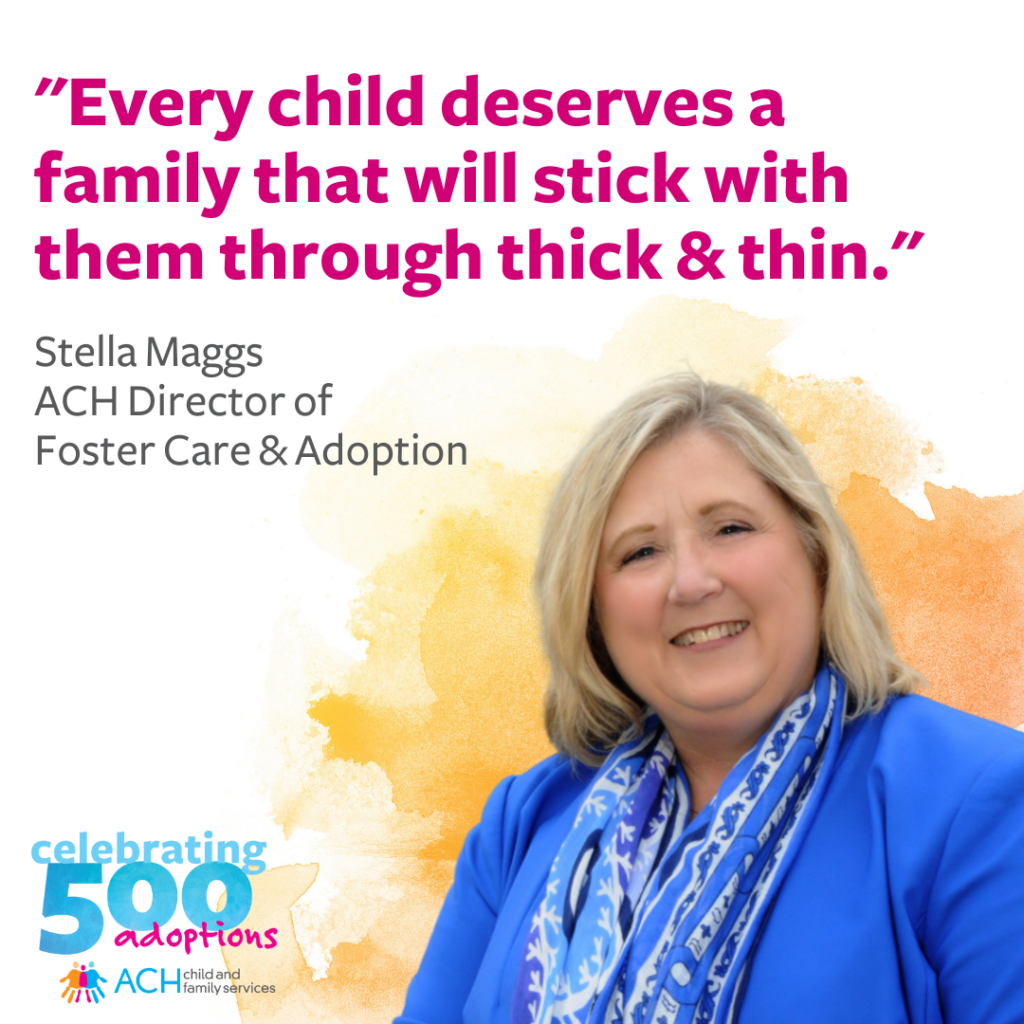
In her decade spent at ACH, Foster Care & Adoption Director Stella Maggs has helped more than 500 children get adopted by safe and loving families.

Stella’s history with foster care and adoption goes all the way back to when she was a child in foster care. She and her two brothers were adopted as children.

“I want to help other children find a forever family and have the great experience that I had,” said Stella.

For more than 25 years, Stella has made it her mission to find the best possible homes for children in foster care.

“Every child deserves a family that will stick with them through thick and thin,  to love on them and treat them like their own children because they should be their own children,” said Stella.

Even during a Pandemic, kids can't wait

When hurdles come their way, Stella and her team always put children first. When the COVID-19 pandemic hit, her team pivoted to make sure Foster and Adoptive parents were receiving their training and kids were not put on hold.

“Watching my staff turn on the dime and adjust was awesome,” said Stella. “No one blinked twice, they just jumped up and did whatever they needed to do to make sure our kids were safe, and our families were well taken care of.”

The pandemic also allowed Stella to spend more one-on-one time with her families. Even after 500 adoptions, Stella enjoys keeping up with each family and seeing how their children have grown over the years.

Stella remains close with many of the families, and one touched her heart in an amazing way. During her second year at ACH, she met a couple, who already had two biological children, that were eager to adopt a child. With doubts the family would be open to it, Stella asked if they would be interested in adopting a sibling group of four.

“I thought, ‘there’s no way they are going to take a sibling group of four.’ He called me the next day and he said, ‘Stella, we want to move forward with these kids. We really think they’re the ones for our family.’”

After several visits, and going through the adoption process, the couple adopted all four siblings.

“I presented all four siblings, thinking,  there is no way they would be interested in a sibling group of four, especially since they had two children already which would make them a family of eight;  but they jumped on it, and they have been wonderful advocates and parents for these children,” said Stella. “It has been amazing to watch them all grow and to see them grow as parents to these kids.”

A passion to serve

“Stella came to ACH in 2011 as the Adoption Program Manager and has continued to invest in and build our foster care and adoption program,” said Melissa Opheim, ACH Chief Operating Officer.

“If you ever talk with Stella about adoption, you can immediately see her passion and dedication to children and families and her love for what adoption means to so many of the children we serve, a family of their own.”

Dedicated to ensuring a child's safety

Stella also thinks of the parents who welcomed a young boy into their home who was diagnosed with cancer just months before his adoption was finalized.

“This family went through everything with him,” said Stella. “Bone cancer, multiple surgeries, all kinds of things to find something to help him.”

The family knew  the boy would not live long enough to have the adoption finalized, but they asked ACH and the Texas Department of Family and Protective Services if they could change his last name to their family’s name before he passed.

“They were committed to him from day one and it didn’t matter what anybody threw at them or what he went through, they were there,” said Stella. “That is the kind of family ACH recruits and trains. Families who will take care of a child no matter what.”

For Stella, the most rewarding part of her job is seeing children thrive with their new families, despite the trauma they have experienced. When she sees 500 adoptions and 500 children that have gone to a forever home, and have had a great life with their families, it’s priceless.

“To think you just had a small part of that, of placing a child with a family, feels great,” said Stella. “ “This is why I am so proud of my team because they are so dedicated to ensuring a child’s safety. To ensuring our children get a forever home or go back to a home that can now truly help this child grow into anything they want to.”

Stella feels the passion her team has is consistent with every program at ACH.

“Everyone in this organization has a passion for children, all the way from our CEO to our maintenance team, and it comes through in everything that we do.”

Meet James

When James was 17 years old, his father was struggling to care for him at home. His father became disengaged and was ready for James to start living on his own. James’ father dropped him off at ACH’s Youth Emergency Shelter, and this devastated him.

The Pat O’Neal Youth Emergency Shelter at ACH is the only 24-hour emergency shelter in Tarrant County offering 24/7 safe shelter to runaway and homeless youth and trafficking survivors, ages 10-17. 

When James first came to the shelter, he struggled with peer interactions and behavioral issues. Every day, ACH staff worked with James to build a trusting adult relationship. Over time, James started to open up to staff and began to accept their help. He became invested in his future and began to change his behaviors and outlook on life.

“James figured out that he mattered, and his future was important,” said Stephen Parker, ACH Homeless Services Program Manager. “Our relationship with James allowed us to help guide and mentor him, and together we put him on a path for success.”

James recently got accepted into ACH’s LIFE Project. LIFE is a supervised independent living (SIL) program that promotes self-confidence and self-sufficiency for young adults aging out of the foster care system and homeless young adults.

“James’ progress, change in behavior, and focus was outstanding and exactly why we do this type of work,” said Stephen.

Many of the youth in ACH’s shelter share similar stories to James. They are in most need of safety and shelter, as well as trusting adults to show love and support. To learn more about the shelter, click the button below. 

With open arms and open hearts, ACH welcomes youth in need

“I thought my life was over at 17 and they showed me how it had just begun and to fight for a better life for myself and others.”

The Morris program at the ACH Wedgwood Residential Campus provides 24-hour care for youth ages 14-17 who are difficult to place in a permanent family setting. These children have been traumatized to the extent that it is difficult for them to express their emotions appropriately, leading to behaviors like aggression, running away, emotional outbursts, drug experimentation and early pregnancy.

When we received this message, we immediately shared it with our Morris team. She is, after all, “going after the dream they instilled in me.”

Dear ACH,

I am eternally grateful to the Morris home and the ACH programs—they have helped so much in my adult life. In the Morris home, I was taught how to budget and to cook, not to mention the value of friendship and kindness.

I know that these things might sound funny, but before I came to Morris, I was 17 and numb. I was unimpressed with the world and anything to do with other people. I knew nothing of how to take care of myself and was homeless as a child more than once. I felt that because I had no biological family to rely on, I didn’t need anyone nor did I want anyone to “mess with me.” I had addiction problems and countless behavioral problems that I didn’t see as an issue. I was always running away and every time I was up to no good. I was self-harming and saw no point to life.

When I got to Morris, the staff welcomed me with open arms and open hearts and shared their priceless wisdom of life with me. I learned how to care for others and for myself. I learned to be kind and to make friends, which I had plenty of that year in school! They taught me to be passionate about things. I threw myself into softball and music and art. They taught me how valuable life can be and that you just have to push through the hard parts.

“I use the skills they taught me today as an adult and I have so much more to learn, but they absolutely jump-started my life.”

I can’t even begin to explain how grateful I am to the staff for the days I would sit in my room with one of them and cry and they would just sit and listen. So many of the staff at Morris home have been through the same types of situations as the kids that are currently there or were there in the past and they taught us how to persevere and thrive.

I am now 20 years old and going after the dream they instilled in me. I’m going to be in social work and hopefully get my recreational therapy degree so I can help kids that are in situations like I was. I thought my life was over at 17 and they showed me how it had just begun and to fight for a better life for myself and others. I use the skills they taught me today as an adult and I have so much more to learn, but they absolutely jump-started my life.

Thank you 100 times over, ACH.

                                             Jasmine

This Morris transitional living program focuses on factors that have been proven to help youth be successful post-foster care. We aid in their academic achievement, vocational planning and by assisting them in finding gainful employment or volunteer experience. We also help these youth to attain a valid ID or driver’s license, to improve their ability to manage their own behavior, to cope with stress, and to gain insight into their interests and strengths.

To learn more, visit achservices.org/programs/morris.

Meet Abigail, Mother & Survivor

With the help of ACH’s Families Together program, Abigail has taken back control of her life after experiencing domestic violence.

You, your kids, and the clothes on your back. That’s all most mothers have when they are escaping a violent abuser.

In Texas, one in three women will be victims of domestic violence in their lifetime. Intimate partner violence alone affects more than 12 million people each year and can affect anyone regardless of race, gender or income.

As the COVID-19 pandemic persists, so do the challenges it brings. This year, it’s especially important to highlight intimate partner domestic violence as a growing issue in Dallas-Fort Worth. With more families feeling the stress of the pandemic, instances of abuse can arise or worsen. In 2020 alone, 19 adults and two unborn babies were killed in domestic violence homicides in Tarrant County.

Abigail experienced years of physical, and mental abuse from the father of her children before she was able to escape. And just when she was on the verge of independence, the COVID-19 pandemic slowed her recovery.

ACH’s Families Together program helped Abigail take back control of her life and put her on a better path for herself and her children.

What is Families Together?

Families Together provides transitional housing for single mothers and their children who are experiencing homelessness due to intimate partner domestic violence. The program offers a safe and stable living environment while they work to overcome the trauma that led to their homelessness and return to independent living.

This is Abigail's Story.

When Abigail first met her partner, Ben*, she already had a young daughter from teen pregnancy. Becoming a mother so young gave Abigail pride, determination, and a strong sense of independence.

After just a few years into their relationship, Ben started to become more controlling. Abigail mistook his actions as caring.

His jealousy led to him asking Abigail to quit her job and become a housewife.

“I thought he just wanted to take care of me, but it slowly started to become more and more of a pattern.”

Abigail soon wasn’t allowed to leave the house. Ben also took away her phone and social media, so she didn’t have a way to ask for help.

“I felt like I couldn’t breathe, and I was walking on eggshells every day,” she said. “He was becoming more and more controlling.”

With promises to change and be a better man, the two got engaged. However, Ben’s grip on Abigail intensified when she became pregnant with their son.

“Once I had my son, it started to become physical,” said Abigail.

With no family in Texas, Abigail had no one to turn to. She and Ben were living with his mother, who refused to help Abigail, even though she witnessed the abuse.

“I was under his eyes at all times. And not just under his eyes, his mom would tell him when I took too long at places,” said Abigail. “I felt like I was always being watched.”

Both Ben and Abigail grew up with abusive fathers. For their families, this was just their way of life. When Abigail confronted Ben’s mom, she would blame Abigail’s disobedience for the cause of the abuse.

“I knew that she would not protect me if anything happened,” Abigail said.

One evening after a fight became physical with Ben, Abigail tried to leave. Ben locked her in the garage and wouldn’t let her out.

“I went out through the garage and ran out, and he dragged me by my hair from the driveway back inside in broad daylight,” said Abigail. “That’s when I knew that this was going to end with me being killed.”

That’s when Abigail planned to make her escape. She would ask Ben for his phone so that she could pay bills online, and she would use that time to contact her friends on Facebook and ask for help. One friend had experienced abuse as well and told Abigail, “You don’t need to tell me what is going on. Just tell me when you need me to pick you up and I will be there.”

After their next explosive fight, Abigail took her kids and left to stay with her friend. However, it wasn’t long before Ben started to show up at her friend’s home and became physical once again.

Feeling unsafe in her own home, Abigail’s friend asked her to leave. Abigail and her kids were now homeless and living in her car. A counselor at her daughter’s school helped get them into a shelter, where she was connected to the ACH Families Together program.

Families Together Provides a Safe Space

When Abigail first entered Families Together, she was very anxious and felt hopeless. She was now a single mother of two children with no job and no plan.

“The staff at ACH were very welcoming, and they gave me the space I needed,” she said. “They didn’t make me feel overwhelmed.”

Abigail hit the road running on the path to recovery. She quickly started counseling, attending group sessions with other mothers, and began applying for benefits for her and her kids. She eventually got a job and finished her cosmetology degree.

“When Abigail entered our program, she was determined to make a change and make a better life for her kids,” said Sharla Hosford, Families Together Family Care Specialist. “She didn’t want her daughter to repeat the same cycle that she saw her go through.”

After entering the program, Abigail started to see changes in her daughter. Her daughter witnessed a lot of the abuse and understood what was happening. ACH started to provide counseling for her as well.

“I do believe that it is a cycle that has been broken. She was seeing the same things I was seeing and that is why I felt I needed to help her,” said Abigail. “I saw myself in her so many times and I knew I needed to get help for both of us.”

Overcoming Hurdles from the COVID-19 Pandemic

Abigail entered Families Together at the start of the COVID-19 pandemic which made getting a job increasingly difficult. At the time, only essential workers were being hired and there was a waitlist for rideshare and food delivery services.

On a whim, Abigail saw that a daycare center was hiring and applied. She got the job but every time there was a COVID-19 exposure the daycare was shut down and she had to apply for unemployment.

Only two months into the program, Abigail hit another bump in the road. She was driving on the highway with her two kids in the car when it caught on fire. This totaled her car and she had to save up even more to get another.

Then, when Abigail tested positive for COVID-19, the staff made sure she had everything she needed. They brought her a refrigerator and provided all her meals.

 COVID-19 also brought more loss to Abigail’s life. While in the program she lost three close friends to the virus. One of those, she didn’t find out about until Christmas morning.

“Staff in Families Together always knew what to say and how to calm me down,” said Abigail. “It was a scary time, but the staff was always there for me.”

Looking Ahead

Because of her strong motivation and hard work, Abigail was able to complete the Families Together program early and move into an apartment.

Although she does have a degree in Cosmetology, Families Together showed Abigail that she could help women with similar experiences. Today, she is in college, working to become a social worker.

Abigail also has dreams of writing a book about her experiences with domestic violence to help others who are going through it.

“When she left ACH, she was empowered,” said Sharla.

Abigail’s Message to Mothers

Abigail is still close to the staff at Families Together and is very thankful for the help she and her children received. For her, the most beneficial part of Families Together is time—the time they give you to save money and work to rebuild their life.

“Being able to have that time to process while they are here in a safe environment and look at what they went through and address that trauma and heal from that trauma and learn to recognize red flags,” said Sharla, “They see who they are and what they can do and go from there.”

For other mothers or partners who are experiencing domestic violence, Abigail said to listen to others when they are seeing the signs and expressing concern. If no one is expressing concern, ask questions to others about what you are experiencing. “Is this normal?”

“An outside perspective can be a really big help,” said Abigail. “They can be what prevents your family from having to plan your funeral.”

If you or someone you know needs help, please do not hesitate to contact ACH at 817-335-4673. (Call 9-1-1 for emergencies.) To learn more about ACH’s Families Together program, visit ACHservices.org/Families-Together.  

If you would like to support ACH in our fight against domestic violence, please visit ACHservices.org/get-involved/give-now/

*Name has been changed.

Meet Jayden

Meet Jayden

When five-year-old Jayden entered ACH’s Behavioral Care program, he was dealing with extreme behavior issues and trauma stemming from entering foster care due to parental neglect.

At first, staff described Jayden as being high needs with toddler-like behaviors. He had trouble managing his emotions and would often become aggressive to get attention. Jayden also had issues with trying to run away to his mother.

“When you have someone who is so young and has experienced so much trauma, it’s hard to help him understand there are other ways to handle emotions,” said Kaitlyn Smith, Behavioral Care Supervisor.

For so long, Jayden learned certain techniques on how to survive while living with his mom and then in foster care, but those were unhealthy tools. During his stay, the staff taught him how to express his needs in a healthy way.

A Family Approach

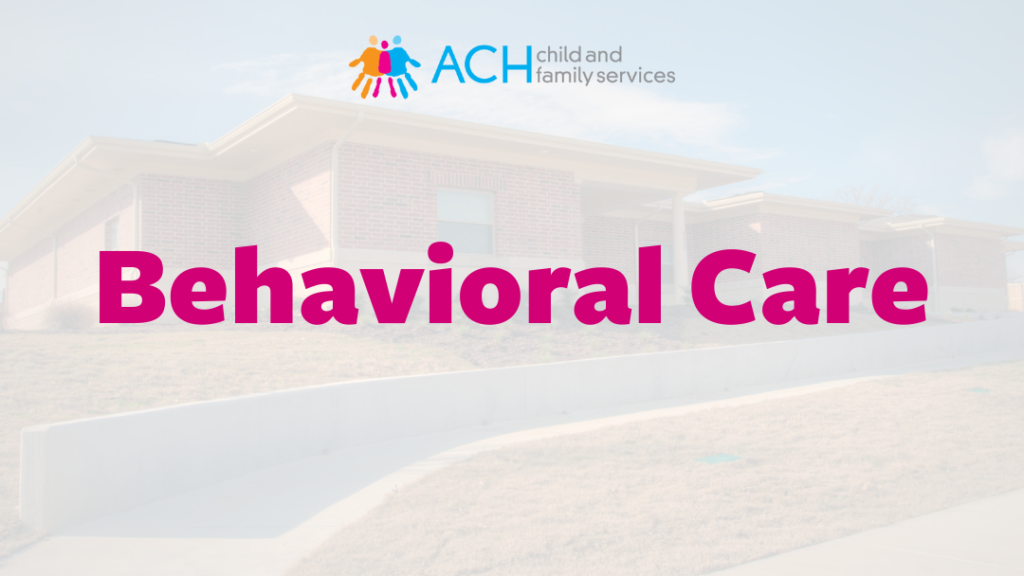
Behavioral Care serves kids, ages 4-12, with moderate to severe behavior challenges. This short-term residential therapy program provides a safe and structured environment that teaches adaptive behaviors and supports successful child development.

Behavioral Care is unique because it is set up in a home-like setting with a family feel, where the kids get to participate in normal activities like decorating their bedrooms and celebrating their birthdays.

“We get to know the kid and look past the behavior,” said Kaitlyn. “In a psych hospital, they are there to manage behavior and we are here to love the kid.”

During his stay, Jayden was able to accurately identify his emotions and his escalations became much shorter. He learned to gain control of his impulsivity.

ACH’s Behavioral Care program is located at ACH’s Wedgwood Residential Campus in Southwest Fort Worth and is home to residential programs like the Morris Program, as well as crisis intervention programs like Summit and Turning Point.

“In a psych hospital, they are there to manage behavior. We are here to love the kid.” —ACH Supervisor Kaitlyn Smith

“If he was feeling overwhelmed, he would tell staff he needs to go to his room because he needs a reset and calm down,” said Kaitlyn. “It was awesome to watch him identify his behaviors and big emotions and know what to do about it.”

One of Jayden’s biggest areas of concern was him jumping and running on the dinner tables. As a natural consequence, staff told Jayden that he had to wipe down the table if he gets on it.

“It only took him two to three times and he never did it again,” said Kaitlyn. “He learned that his actions had consequences and he learned other ways to get our attention.”

Staff eventually got to see Jayden’s personality come out, including his incredible humor. He even began to show empathy for the other children in the program.

Working Together

Most of the children who arrive at Behavioral Care are in foster care or will transition into foster care. The program encourages family reunification whenever possible and ACH staff work with the parents to ensure long-term success after the kids graduate from the program.

“When the parents are in the picture, it is so important that they too are a part of the healing process,” said Kaitlyn.

For Jayden, he would be going home to his birth mother. She had a history of drug use and worked hard to become sober to raise Jayden.

Staff provided Jayden’s mom with an individualized parenting class to teach her strategies that worked best for Jayden while he was in Behavioral Care.

“We gave her techniques on how to connect with Jayden, how to empower him, and how to correct his behaviors in a way that is beneficial for everyone,” said Kaitlyn.

They also empowered her as a mother and reminded her she is not alone—individualized support she might not have gotten from another program or hospital.  

Toward the end of Jayden’s 11-month stay in Behavioral Care, Kaitlyn said she was not only proud of his progress, but his mom’s as well.

“The coolest thing I got to do is encourage her in her journey,” said Kaitlyn.

If you would like to support the children and parents in our Behavioral Care program, ACH offers many ways to get involved. To get started, visit https://achservices.org/donate-now/

Spreading Joy in LIFE

ACH Young Adult Arranges Special Celebrations for Peers

In ACH’s LIFE Project, our staff is dedicated to providing care, support, and most importantly, love to the youth in our programs. When we see the youth in our care share that same love with their peers, it’s an especially proud moment for our staff.

K, a young lady in LIFE, took the initiative to plan birthday parties and special celebrations for her peers in the program. When K first arrived in LIFE, the staff threw her a birthday party. She held onto that happy feeling and wanted to be a part of planning those celebrations for the other youth.

“I thought I should do the same for other people to make them feel this good, too,” said K.

K takes the time to meet with staff and plan out all the details. With each celebration, K makes sure to find out what each person likes and the activities they enjoy.

 “The older you get, the less you care about your birthday,” said K. “This is their special moment.”

Creating Memories

For many of the youth in LIFE, the first birthday they celebrate in the program is the first birthday they’ve ever celebrated.  

“Many of our girls come from different backgrounds and have different interests – but these are times that bring us together,” said Cassie Morgan, LIFE Project Mentor. “Watching them use their gifts and contribute is just amazing.”

K’s generosity and hard work also extend to the volunteer mentors who participate in activities with the young adults in LIFE. During volunteer appreciation week, K met with the youth in LIFE and led a project to create gift bags for each mentor.

“It felt good because they always do stuff for us,” said K. “They don’t have to come, and they do. I just wanted to do something special for them.”

What is LIFE?

ACH’s LIFE (Learning Independence from Experience) Project is a program that builds self-confidence and self-sufficiency in young adults ages 18 to 21 who are homeless or are in extended foster care. Young adults who are on their own are given guidance and support in developing life skills—such as applying to college, entering the workforce, and preparing to live independently.

K, a young adult in ACH’s LIFE Project has been throwing birthday parties and celebrations for her peers in the program. 

Reflection of Growth

According to ACH Staff Mentor Stephanie Henry, the thoughtfulness and care K has shown to her peers in the LIFE project reflects one of the many leadership skills she has developed at ACH.

“K has grown significantly in the past year since coming to the LIFE program,” said Stephanie. “She has grown in knowledge of cooking, learned how to take better care of herself and how to garden.”

While planning the events is fun for K, her favorite moment is when she reveals the surprise.

“I love seeing their faces,” said K. “They always look so happy, and that makes me happy.”

Support K in creating special moments for the youth in ACH’s LIFE Project, by getting involved at ACH today!

K helps prepare food for her and her peers in The LIFE Project.

Caring for kids in your family…who aren’t yours?

ACH’s New Program is a Unique Solution Providing Much Needed Resources to Kinship Families

Chantel Bedlington plays a  vital role in helping ACH Child and Family Services create a program that will change the lives of families caring for relative children.  

Chantel, ACH’s Kinship Navigator Support Specialist, has been reviewing data from a voluntary survey and connecting with kinship families as well as organizations that serve kinship families to build a network of resources, education, and support to build our Kinship Navigator program.

“The Kinship Navigator program will help kinship families with their unique needs and connect them to much-needed resources, support groups, as well as financial assistance, legal assistance, and more,” said Chantel.

ACH is one of four organizations selected by the Texas Department of Family and Protective Services to develop and implement a program to serve kinship caregivers.

Because of ACH’s broad range of programs that help children and families, Chantel has been able to assist many kinship families before the program has even launched. Kinship families have been able to utilize AIRS, ACH’s 24/7 bilingual crisis hotline, Real Help for Real Life, which provides free youth and family counseling, and our Kinship Connections support group. The Kinship Navigator Program has also partnered with Texas Grandparents Raising Grandchildren support groups in North Texas.

What is kinship care?
A kinship family occurs when a grandmother, aunt, uncle, or sibling is raising a family member. Kinship families can also include children placed with close family friends, also known as fictive kin. In either case, when a child is placed with a family member, it’s new to both.
Close to home

Chantel understands the needs and struggles of kinship parents because she is one herself. Chantel and her husband began raising relative children they had only met once before the placement. She also has two biological children and one adoptive child.

Two years ago, Chantel got a call from Child Protective Services in Kansas saying that her husband’s stepsister’s children would be placed in foster care if a family member couldn’t care for them.

“What do you do when you get that call,” asked Chantel. “I don’t want to be that person that stands in front of these kids one day and have them ask, ‘You are my family, and you didn’t come?’”

So, they went. Chantel and her husband packed up their car and drove to Kansas to pick up the children. Almost as soon as the kids were in Chantel’s care, she was faced with a lack of support and resources to help her kids since their DFPS case was closed as soon as they were picked up by family.

For the last two years since the placement, Chantel had to fight to get the kids on Medicaid and get adequate resources for their critical health needs. She had to obtain a lawyer to get legal guardianship. Even getting the kids enrolled at their neighborhood schools was a struggle.

“I had to fight for everything,” Chantel said.

This experience led her to ACH.

“When I saw this position at ACH, I wasn’t necessarily looking for a new job,” she said. “I was just like, ‘Wow, somebody has got to do that. Somebody has got to help fight for these families.’”

Chantel has built strong relationships with local kinship families from the very beginning of the Kinship Navigator program. These relationships were extremely rewarding and beneficial in her role as a kinship parent.

“Before I started working with ACH, I didn’t know any other kinship caregivers,” said Chantel. “It has been wonderful to connect with them and know that we are on this journey together.”

Chantel Bedlington, ACH Kinship Navigator Support Specialist
ACH Kinship Services Dig Deeper

That connection is almost as equally important as financial assistance and legal aid for kinship parents.

Many kinship caregivers, especially those who are grandparents, are again having to raise children during a time when none of their friends are. They don’t have anyone to relate to in their lives.

Not only that, but many are dealing with the guilt of their children’s choices that led to their grandchildren entering their care. It is hard for them not to feel shame for their children’s choices that led to things like addiction or imprisonment, which caused them to lose their children.

“Many of our grandparents feel isolated because of that,” said Chantel. “They need to know their adult children’s choices are not their fault.”

Most people don’t realize kinship families have unique needs: They are raising the children of a family member and experiencing the many emotions involved in that. The family dynamic can be a very difficult one to navigate for the kids and the caregiver. For many of the children going into kinship care, they are dealing with the trauma they experienced with their parents. Oftentimes, even though the children are going with family, they don’t have existing relationships with the family they are being sent to live with, which can be traumatizing.

“Foster and adoptive parents have the advantage of being trained on trauma, what to expect and how to help a kid who is losing control,” said Chantel. “For kinship families, they just get a call.”

What to Expect When You’re Not Expecting

To combat this common problem, Chantel has begun developing a guide to help kinship parents navigate their new role: What to Expect When You Weren’t Expecting. It will teach parents how to get the children enrolled in school, what to expect in the licensing process, and how to apply for Medicaid. Becoming a licensed kinship foster parent offers benefits like monthly financial compensation and long-term support. However, the Kinship Navigator Program is ready to help those who are not eligible or interested in seeking licensing. The guide will also have recommendations for articles, podcasts, and books on kinship and trauma-informed care. 

The Kinship Navigator program is planned to start this Fall, and it will benefit kinship families in Tarrant, Parker, Palo Pinto, Johnson, and Hill counties.

If you are a caregiver, legal professional, child welfare worker, educator, or in law enforcement and would like to participate in assisting us in our planning process or get more information, please register by clicking here.

A Community of Support: Volunteer Mentoring at ACH

Transitioning into adulthood is a challenging time for anyone. The number one factor in helping young people through challenging times is the support of at least one caring adult or ideally, a community of adults, who can provide support and guidance in many ways.

The young adults in ACH’s LIFE Project are facing all the challenges and responsibilities of adulthood on their own. As a result, we must recruit a community of supportive adults who can help them with this major transition. Mentoring does not remove every obstacle but gives them the important knowledge that they are not alone.


Qua’ (far left) chats with a group of mentors from Connections for LIFE during a night out at Alley Cats.  (Pre-pandemic)

“Mentoring at ACH gives our young adults a community that walks beside them, through all the ups and downs, to help move them forward,” said Kate Faggella-Luby, ACH’s Volunteer Mentor Coordinator.

ACH’s volunteer mentors are committed individuals who together form a community of support for young adults in LIFE through two groups: Connections for LIFE for the young men; and, Circle of Caring for the young women.

Volunteer mentors participate two to three times per month in fun group activities with the young adults and other volunteers to build connections and provide a sense of belonging for them,” said Kate.

Before the pandemic, the groups would get together to cook a meal, play a game outside, or leave campus to visit a museum or see a movie. They also celebrate birthdays, graduations, and other big accomplishments. In the past year, they’ve shifted their activities to Zoom, with some socially distanced events.

BUILDING BRIDGES


Volunteer Mentors celebrate milestones with the young adults in LIFE, including graduations as seen here in 2019.

Qua’ has been a part of the LIFE Project since July 2018 and he’s actively participated with the volunteer mentors.

“Connections for LIFE was the highlight of my time at ACH,” said Qua’. “They gave us opportunities and resources, and just having dinner and interacting with them was engaging and fun.”

Qua’ met his mentor, Dennis, last year and the two bonded over stand-up comedy and rap music.

“He’s old-school and I’m new school,” laughed Qua’.

It wasn’t long before Qua’ began to open up to Dennis and the pair grew closer.

“I try to give them the sense of being wanted and appreciated,” said Dennis. “I try to guide Qua’ the same way I do my own son.”

For Qua’, Dennis became the first male role model he ever had, and one of the first adults to make him feel seen and heard. Experiencing years of emotional abuse made him feel ignored and abandoned, which made it hard for him to develop a connection with trusting adults.

That changed with Connections for LIFE.

“Getting the chance to know all these volunteers is definitely a milestone in my development,” said Qua’.

Dennis believes that taking a vested interest in these young adults creates a much larger impact in the long run, for both them and the community.

“They’ve never had anybody take a vested interest in them or care about them, so when you show them that, they know how to give that love and care back into the world.”

Qua’ encourages other young adults in LIFE to get the most they can out of the mentorships.

“Without those friends, those bonds, and those connections, you’re not going to make it very far,” said Qua’. “It’s good to know that you’re appreciated every once in a while, and that there are people you can depend on.”

That’s what Kate wishes all young adults in LIFE receive from the volunteer mentors.

“The fact that the mentoring group shows up for them time and again, sends a message that they matter, that they have something to offer, and that the world can be a safe and good place for them,” said Kate. “That sense of belonging, of receiving and giving support, is what I hope they take away from the experience.”

LOOKING AHEAD

Qua’ will soon graduate from the LIFE Project and venture out on his own, but he and Dennis still have plans to remain close. For Dennis, the most rewarding part of the mentorship will be getting to see Qua’ “spread his wings and fly.”

If you’re interested in becoming a volunteer mentor and making an impact on ACH’s young adults, reach out to Kate at Kate.Faggella-Luby@ACHservices.org to get started.